Around the year 1400, the Northern Netherlands faced several storm surges. For instance, in the autumn of 1403, the dike of the Purmer-Ye broke through and flooded the region. According to legend, girls from Edam crossed Lake Purmer intending to milk cows. In the water, they found a filthy, naked woman. This marked the beginning of the ‘Mermaid of Edam,’ which was soon published internationally.
At the end of the 15th century this event was mentioned in the Chronicle of Holland. Where did this woman, who was soon nicknamed the ‘green sea woman,’ come from? Was she perhaps a shipwrecked woman? She could speak, but no one understood her language, and she understood nothing of the Dutch dialect.
She was washed and dressed in women’s clothing. After Edam, the ‘green woman’ moved to Haarlem, where she lived for many years. Because she was accustomed to paying some respects to the cross, she was buried in the churchyard.
From Legs to Tail
The Belgian Cistercian abbot Aegidius Roya mentions in his annals for the year 1403: “The sea was made unsafe by pirates, but most of all by the English.” So there were buccaneers, perhaps Portuguese or from Algiers. Maybe the woman was Irish or Scottish. We do not know, but we do know that she had legs. But that is about to change. In the *Oude hollandsche geschiedenissen ofte corte rijmkronijck* from 1645, the story is included by the (blind) preacher Wachtendorp, illustrated by a spinning woman with a fish tail. She has been metamorphosed into a siren and is nationally known. Soon she will gain international fame.
The statue in the Edam city gate.
The Middelieër, Purmer, or Westerpoort, one of the seven city gates of Edam, was an elongated, low structure with a rectangular frame around the gateway on the land or Purmer side. In 1615, the gate was renovated, and thousands of Frisian and Gouda clinkers were incorporated into the gate. Consequently, the gate had no upper floor; this is related to the wind capture being obstructed by a high gate, against which millers objected.
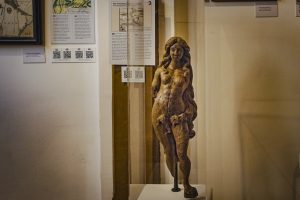
Of interest is the payment made by the city to Neel Jans, landlady of the inn ‘Het Moriaenshoofd’. She received fourteen guilders for ‘a plaque’ incorporated into the gate. Images show a natural stone pediment in the entrance on the land side, against which a small statue was placed: the mermaid caught in Lake Purmer in 1403. The plaque bears the following text:
This statue erected here in remembrance
What is captured in the Purmermeyr
Anno 1403
The gate was demolished in 1836. After the demolition, the statuette was stored in the attic of the Kleine Kerk. When Pierre Cuypers was in Edam for his work on the developing Edam Museum, he brought several objects with him to give them a place in the Rijksmuseum. This proceeded as follows:
Hendrik Jan Calkoen (1848-1923), former mayor of Ilpendam and Landsmeer, heeded the request of the Municipal Executive by proposing, together with Alderman Tuyn, to transfer stone building fragments and wooden objects from the nave of the demolished Kleine Kerk to De Stuers and Cuypers. (This also includes the mermaid placed in the attic, LdJ). In this way, they were able to ensure that these objects were preserved. The State was to bear the costs of this, plus the costs of transporting it to the museums in Amsterdam. Cuypers proposed to the minister that he accept this offer, for which no more than 250 guilders had to be paid. The minister agreed, and the architectural fragments and columns were placed in the museum garden of the Rijksmuseum in Amsterdam, next to what is now called the Fragment Building.
In the new exhibition ‘From Yredam to Edam; straight through Edam’ in the Town Hall, the statuette can be seen, depicted in the city gate in the film made by Steven Maas, “Five trips through Edam in the autumn of 1650”. And, even better, you can now admire the original statue in the Coopmanshuys, in the exhibition ‘Edam in 14 steps’ on the first floor!