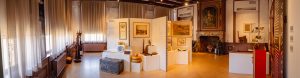
We are very proud to present you our new exhibition: ‘From Yredam to Edam’. It is interesting, playful and really a musdt-see!
The prosperous little town of Edam grew over centuries out of settlements along the river IJe that flowed from the Zeevang from North to South and into the Zuiderzee. Later, the town developed in a West-East direction, from the Purmer lake to the Zuiderzee. What had been a village of mainly farmers and fishermen, “Yredam”, obtained city rights in 1357 as Edam. In its heyday in the 16th Century, Edam was an important hub of trade and commerce. Later, its economic power declined, but we can still see the traces in the present-day town. By using the touch screen, you can see how the village of Yredam developed into Edam, and how the shape of the current town is still determined by its contours of yesteryear.
This exhibition takes you on a journey through time: through daily life in Edam over the centuries. The entry hall where you are now standing, gives a picture of Edam in the 17th Century. The exhibition proper starts in the Mayor’s room [Burgemeesterskamer] – where you can also take a digital stroll through the 17th Century town.
We must imagine a built up space with main roads and waterways running from West to East, with often muddy sand roads and paths in other directions. They are surrounded by small houses, interspersed with artisans shops and workplaces, and farms swallowed up by the town. Most of the originally wooden houses are now built in stone because of the danger of fire. The defence-works and the big church (Grote Kerk) are already there, or are in the process of being built.
During the day this is a noisy, bustling place. Horses and carts form the traffic, and sailors and tradesmen calling out their wares mix with the population in the noisy streets. At night it is pitch black, with only some candlelight here and there. People go to bed at sunset. There is no sound but the church bells marking the time, the night-watcher’s rattle and the voices of drunken men leaving one of the many taverns.
You can listen here to what the town sounded like. To our eyes, Edam, like all towns at the time, is also dirty to our eyes and it stinks. That is because of the industry and farms within the town walls and because of the farm animals that roam the streets. Most importantly, people seldom wash thoroughly in these day. You already met the beggar on the stairs – he would have smelt phenomenally. Here you can sniff the penetrating smells that pervaded the town: tar, dung, the salty tang of the Zuiderzee and especially the smell of unwashed people and clothes.